Jua Renewables · Agriculture

Twenty-five years of power, at a price you agree today.

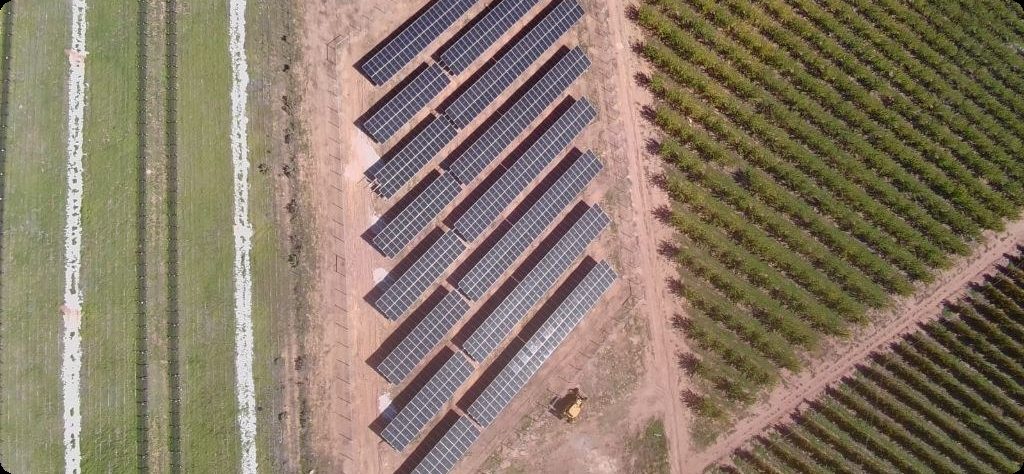
Jua Renewables funds, builds, owns, insures and operates solar and battery systems on commercial farms and agro-processing sites. You contribute no capital and carry no performance risk. You buy the electricity the system makes, under a twenty-five year agreement, at a tariff below what you pay now — and one that rises more slowly than the utility's, every year, for the life of the contract.

35+Agreements signed with agricultural offtakers
25 yrsContracted term from commercial operation
R0Capital cost to the offtaker
75–95%Of site electricity supplied, with solar and storage

The problem

A cost that compounds, in a business that cannot pass it on.

The regulated electricity tariff rose 8.76% for customers supplied directly by Eskom in April 2026, and 9.01% for municipal customers in July. That is not an event. It is a trend that has run for fifteen years and has no published end.

Irrigation, refrigeration, packing, drying and processing are electrically intensive and cannot be deferred, substituted or hedged. There is no forward market for electricity as there is for fuel or fertiliser. The only real hedge is to contract for generation at a rate you fix yourself.

A Jua power purchase agreement escalates at 8%, stepping down to 6%. The utility escalates faster. The chart shows what that difference does over the life of a contract — the shaded area is the saving, and it widens every year.

Indexed cost of electricity · year 1 = 1×
Utility tariff Jua contracted tariff
1510152025 YEAR OF CONTRACT 7.5× 4.8×

Both series indexed to 1.0 in year one, so the comparison holds whatever tariff a given site pays today. Utility escalation held at the 8.76% approved by NERSA for Eskom direct customers from 1 April 2026. Jua escalation per the standard agreement: 8% per annum, stepping to 6%. Illustrative — actual future utility increases are set annually by the regulator.

The model

We build it, we own it, we run it. You buy the electricity.

Jua Renewables is an Independent Power Producer, not an installer. We do not sell you equipment and hand over a warranty. We finance the asset, keep it on our balance sheet for twenty-five years, and carry every risk that comes with owning it.

01

Assessment

We take twelve months of billing data and, where available, interval metering, and model your actual load against generation and storage. The output is a specific system size and a specific tariff for your site — not a generic quotation.

No cost · no obligation
02

Development agreement

A short agreement grants Jua exclusivity for the development period and the mandate to deal with Eskom or your municipality on your behalf. It sets the commercial heads of terms — tariff, escalation, capacity charge and term — that become the power purchase agreement.

Twenty-week exclusivity period
03

Approvals and engineering

We prepare and submit the Small-Scale Embedded Generation application, handle grid compliance and protection requirements, complete the structural and electrical design, and ground-truth the site. This is where most self-funded projects fail; it is routine work for us.

Handled entirely by Jua
04

Construction

Built under a fixed-price contract by our EPC partner using Tier 1 components, fully insured through construction, with performance security and liquidated damages behind the completion date.

Approximately ten weeks from signature to construction start
05

Twenty-five years of supply

Jua owns, insures, monitors, maintains and replaces the system for the full term, and bills you monthly for the energy it delivers. At no point does the asset, or the risk of it underperforming, sit with you.

Commercial operation date onward

Risk allocation

Everything that can go wrong with the system is ours to fix.

This is the distinction between buying a solar installation and contracting for power. An owned system transfers a set of twenty-five year obligations onto a farming balance sheet. A power purchase agreement leaves them where they belong.

Capital

Carried by Jua and its funders. Nothing is drawn from your facilities, and nothing appears as capital expenditure on your accounts.

Performance

Carried by Jua. If the system generates less than modelled, that is our revenue shortfall, not your problem.

Operations and maintenance

Carried by Jua for the full term — monitoring, cleaning, servicing, fault response and spares.

Insurance

Carried by Jua. Construction all-risks, property damage and business interruption cover are in place throughout.

Replacement

Carried by Jua. Inverter and battery replacement in the second decade is funded from a reserve, not from a call on you.

Regulatory and grid compliance

Carried by Jua. We hold the mandate, make the applications and answer to the utility.

The agreement

What you actually sign.

The commercial terms are standard across the programme, and they are set out here rather than kept behind a sales process.

TermStandard position
TermTwenty-five years from the commercial operation date.
Energy tariffSet at signature against your own load and current tariff — indicatively R1.41 to R1.45 per kWh, excluding VAT, and below your prevailing utility rate from day one.
Escalation8% per annum in the early years, stepping down to 6% per annum thereafter, on each anniversary of the commercial operation date.
Capacity chargeA fixed monthly charge for the battery system, which delivers capacity rather than energy and is priced accordingly.
Minimum offtakeAn agreed annual volume you purchase or pay for. It is set below your assessed consumption, so it is a floor, not a stretch.
Capital contributionNil. Jua funds one hundred per cent of the system.
LandA registered lease or servitude over the installation area for the contract term. No transfer of land, and no change to your title.
Surplus energyJua may sell surplus generation to the grid or to third parties, subject to regulatory approval. Your supply is served first.
Environmental attributesCarbon credits arising from the system are retained by Jua unless separately agreed.
ConfidentialityMutual, and POPIA-compliant. Your consumption data, financials and tariffs are not disclosed.

Indicative standard terms. The tariff, capacity charge and minimum offtake for any given site are determined by the assessment in step 01 and are recorded in the agreement itself.

The system

Solar for the day. Storage for everything else.

Solar alone captures only the overlap between generation and load. Adding storage moves surplus midday generation into the evening and early-morning peaks, which is where agricultural tariffs are most punishing and where an interruption costs the most.

874 MWh

Generated each year

On a reference site of approximately 476 kWp, against annual consumption of 1 180 MWh. Yield is modelled site-specifically, not extrapolated.

900 kWh

Stored and time-shifted

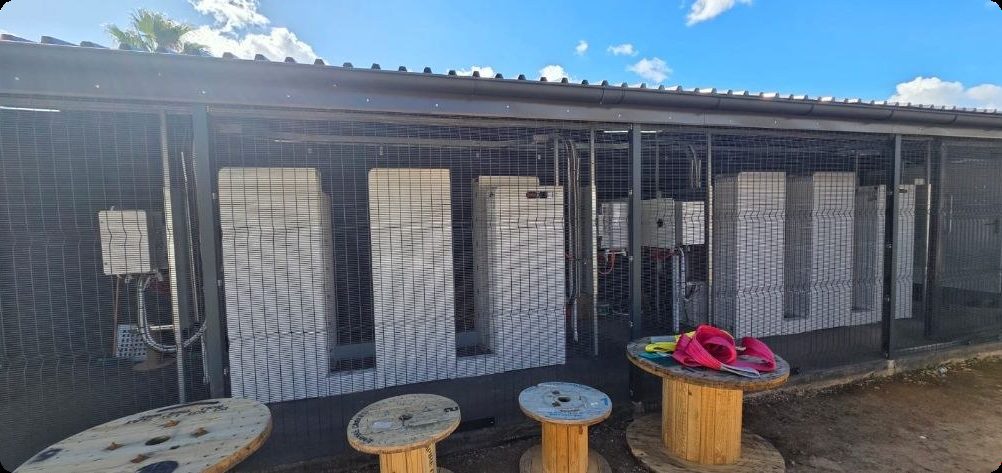
Storage absorbs surplus generation and discharges it into peak periods, cutting demand charges and holding critical load through interruptions.

75–95 %

Of consumption supplied

Direct solar meets about 57% of site consumption. With storage dispatching into evenings and peaks, total supply reaches 75% to 95%.

Grid tied

Integrated, not islanded

Configured for grid-tied operation with export and annual banking across Eskom's 1 April to 31 March cycle, where approved.

Figures are drawn from an executed proposal for a mid-sized wine and fruit production site. Every installation is sized to its own metered load; these are illustrative of the class, not a specification for your site.

Who it suits

Operations where power is a production input, not an overhead.

The model works best where consumption is substantial, daytime-weighted, and tied to equipment that cannot simply be switched off.

Production

  • Wine estates and cellars
  • Deciduous and citrus fruit
  • Table grape and export operations
  • Mixed commercial farming
  • Intensive irrigation

Processing

  • Packhouses and grading lines
  • Cold storage and controlled atmosphere
  • Canning and preserving
  • Drying and dehydration
  • Juicing and pressing

What we look for

  • Annual consumption from roughly 250 MWh
  • Daytime-weighted load profile
  • Roof area, or land not in production
  • A trading history and audited accounts
  • Intention to operate the site long term

Geography

  • Western Cape — established base
  • Northern Cape
  • Eastern Cape
  • Both Eskom-supplied and municipal sites
  • Further provinces on enquiry

Enquiries

Start with your electricity bill.

Twelve months of billing data is enough for us to tell you whether this works on your site, and roughly what it would save you. There is no cost and no commitment to that assessment.

CompanyJua Renewables (Pty) Ltd
Registration number2024/802401/07
A subsidiary ofJUA Investments (Pty) Ltd · Reg. No. K2025/011605/07
OfficesFirst Floor, Constantia Emporium
Cnr Ladies Mile & Spaanschemat River Road
Constantia, Cape Town 7806, South Africa

Request a site assessment

We will come back to you with what the assessment needs and who will handle it.

We treat everything you send under the Protection of Personal Information Act and use it only to assess and respond to your enquiry.