Jua Renewables · Retail & Commercial
Jua funds, builds, owns and operates solar and battery plants on retail and commercial buildings in City Power's supply area. You provide the roof and the offtake, buy the kilowatt-hours at a project tariff below the grid's peak and standard bands — and keep a share of the value the arbitrage creates. No capital, no performance risk, nothing on your balance sheet.
The problem
City Power's FY2026/27 increase is 8.63% across customer categories, and the tariff clock is unforgiving: both daily peak windows — 07h00 to 10h00 and 18h00 to 20h00 — sit squarely inside trading hours, with the winter peak rate at 766.24 c/kWh.
On top of the energy charge sits a maximum demand charge of R461.28 per kVA every month, billed on the worst quarter-hour of the year. One bad minute in January locks twelve months of invoices, and tenant behaviour cannot move that line. Only a battery can.
The same structure that makes the bill punishing makes the opportunity: the grid price varies more than four-fold across the daily and seasonal cycle. A plant that buys the cheap hour and serves the expensive one sits on top of that spread — and captures it three ways at once.
Large Customer time-of-use (LV), winter weekdays, FY2026/27, excluding network surcharge and VAT. The controller charges the battery in the 22h00–06h00 off-peak window and discharges through both peak windows. Summer rates are lower (off-peak 186.35c) and the spread thinner — the model is winter-weighted accordingly.
The concept
Smart arbitrage is the simultaneous optimisation of three independent value streams from the same roof — and retail is the property type built for it, because HVAC, lighting, refrigeration and point-of-sale all peak with the sun.
The centre's load profile follows PV output — not the opposite. Most of what the roof generates is consumed on site, automatically displacing the standard and peak tariff windows where daytime consumption sits.
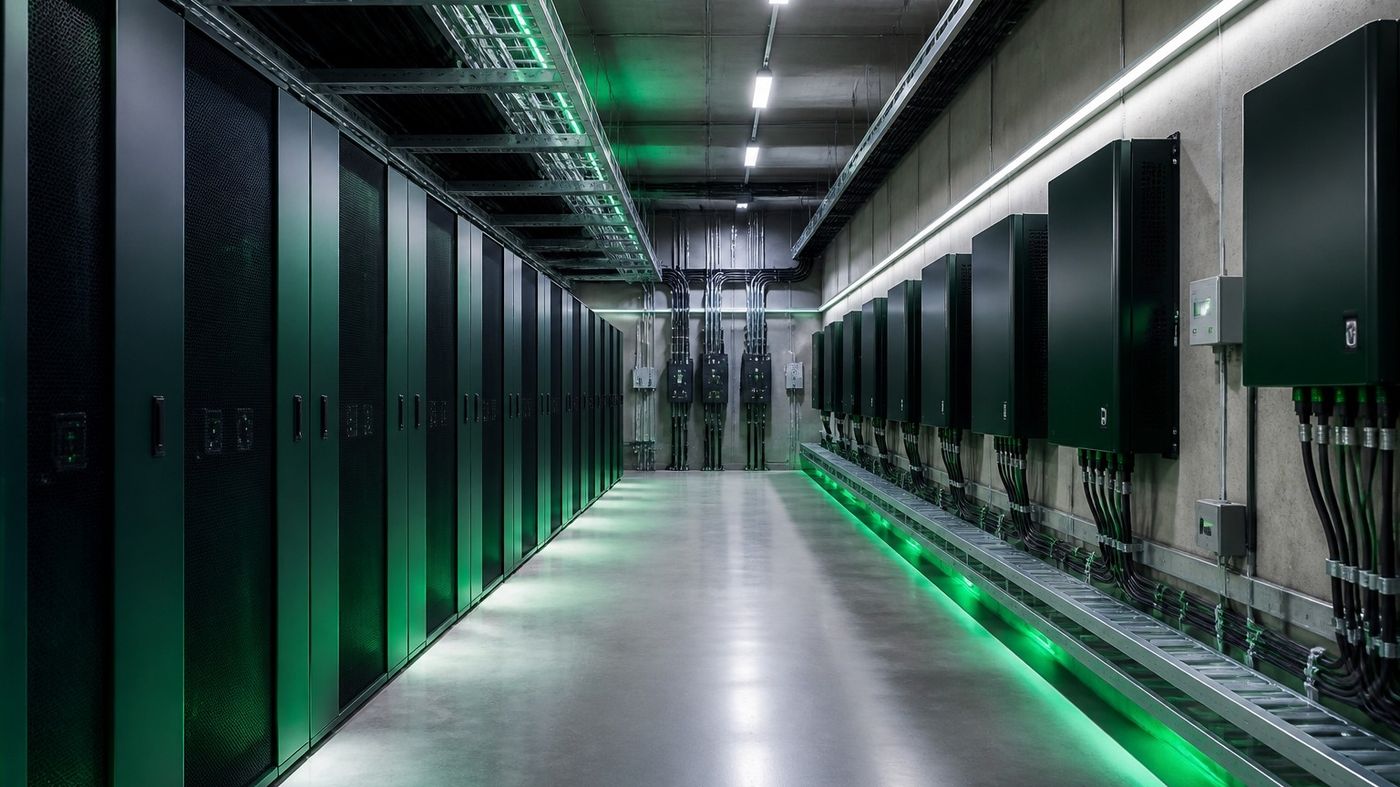
The battery charges from the grid in the 22h00–06h00 off-peak window — permitted under embedded-generation rules — and discharges into the same load through both peak windows. In winter the gross spread is R5.66 per kWh; about R5.38 after round-trip losses.
Battery and solar together shave the worst quarter-hour that sets the monthly demand charge, and the inverters clean the reactive power drawn. On an illustrative centre, a 340 kVA shave is worth around R1.57 million a year in demand charges alone.
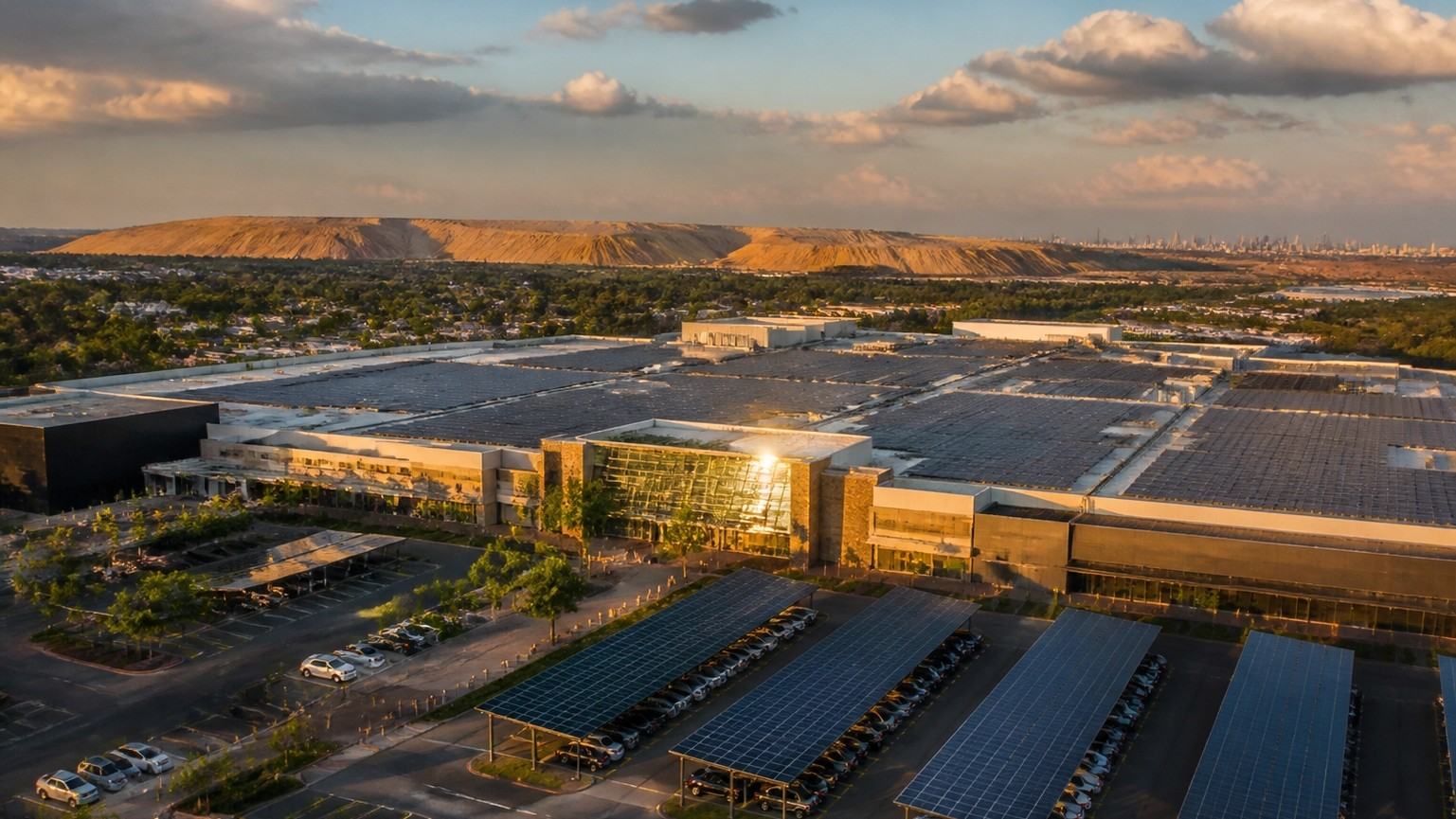
Johannesburg's altitude and clear inland sky put a real flat-roof design at roughly 1 650 – 1 800 kWh per kWp a year — among the best commercial solar resources on the continent, facing north into the sun.
The landlord upside
Zero capital. Zero risk. A share of the arbitrage.
On an illustrative 40 000 m² centre in the southern corridor, the three streams together produce an annual value pool of R3.56 million to R5.10 million, tariff-dependent. Every 10% of that pool retained is worth roughly R356 000 to R510 000 a year — for providing a roof that today earns nothing.
There is no payback period to wait out, because there is no capital outlay to recover: the saving appears on the first invoice after energisation.
Lower recovery at the same gross rent — a sharper leasing proposition.
The kVA peak is shaved — a fixed cost that never moves favourably on its own.
Roof and parking become productive infrastructure rather than a maintenance liability.
Trading, refrigeration, point-of-sale, lifts and security ride through grid drops.
Lower occupancy cost and continuity of trade — defensible arguments at lease renewal.
A measured renewable utility is a green-building signal a buyer will price in.
The model
Jua designs, funds, builds, owns and operates the plant on your asset. Because Jua owns it, Jua carries the depreciation, the insurance, the spares and the replacement risk. The landlord's job is three lines long: provide the roof and the offtake, receive the invoice, keep a share of the value. The whole ask, to begin, is twelve months of your City Power bills.
Send twelve months of City Power bills. We model the baseline and reply with an indicative savings estimate within two weeks.
No cost · no obligationA technical visit for the roof and carport survey, structural review, single-line assessment and half-hourly logging where the metering does not already provide it.
Handled entirely by JuaPreliminary engineering, solar and storage sizing, indicative yield, the value pool modelled stream by stream, and a term-sheet structure for your centre.
A number you can budget againstThe power purchase agreement is negotiated and signed, and Jua runs the full City Power process: embedded-generator registration, bidirectional metering, and an ECSA-signed certificate of compliance to SANS 10142-1 and NRS 097-2.
The paperwork is ours, not yoursConstruction, commissioning and energisation timed around tenant trading hours, not through them. Then monitoring, maintenance and contractually guaranteed output for the full term.
Commercial operation onwardRegulatory position in City Power's supply area: systems under 1 MW carry the standard embedded-generator regime with no generation licence; plants are sized to serve the building's own load as a net consumer, with no export and no wheeling; prepaid metering migrates to the conventional structure before energisation.
Risk allocation
Eight risks sit with us. Two sit with you.
The promise that Jua funds the capital is only credible if Jua also carries the risk. The landlord carries exactly two things: the roof — with any structural reinforcement arranged at our cost — and the commitment to buy the kilowatt-hours the plant delivers, at the contracted tariff, for the contracted term. Nothing else.
The entire plant cost, financed and amortised by Jua and its funding partners.
Generation and uptime contractually guaranteed. If the system under-delivers, Jua earns less.
Inverters, panels and battery packs replaced when warranted, for the full term.
All-risk cover including business interruption, held and paid by Jua.
Scheduled service, spares and warranty management for the full term of the agreement.
Continuous 24/7 monitoring, with your monthly statement of energy delivered and savings achieved.
Embedded-generator registration, bidirectional metering, certificates of compliance — filed and carried by Jua.
Tariff movement, seasonality and consumption shifts — priced and carried by Jua, not passed back to you.
The agreement
The commercial terms are standard across the programme. The tariff, the landlord's share, the term and the escalator are confirmed at term sheet — from your own metered data, never from a brochure.
City Power FY2026/27 Large Customer TOU (LV), weighted annual, excluding surcharges and VAT. The Jua band is project-dependent across R1.70 – R2.40 per kWh and sits below the grid's peak and standard bands at every point in the range; the off-peak band is the battery's charging window, not a buying opportunity.
| Term | Standard position |
|---|---|
| Structure | One long-term power purchase agreement. Jua is the single counterparty for development, construction and operations. |
| Tariff | R1.70 – R2.40 per kWh, project dependent — below City Power's peak and standard bands at every point in the range, with storage, operations, maintenance, insurance and monitoring inside the number. |
| Landlord share | A share of the value pool the plant creates, agreed at term sheet, paid for making the roof available. |
| Guaranteed output | Generation and uptime contractually guaranteed, measured against metered data rather than estimates. |
| Capital contribution | Nil. Jua and its funding partners fund one hundred per cent of the plant, including any structural reinforcement. |
| Grid connection | Your City Power connection stays in place for supplemental supply, off-peak charging and resilience. Nothing is taken away. |
| Site | Roof and carport canopies under a registered lease or servitude for the term. No transfer, no change to title. |
| Compliance | Embedded-generator registration, bidirectional metering and ECSA-signed certificates of compliance to SANS 10142-1 and NRS 097-2 — filed and carried by Jua. |
| Confidentiality | Mutual, and POPIA-compliant. Your consumption data, financials and tariffs are not disclosed. |
Indicative standard terms. The tariff, share and term for any given centre are determined by the assessment in step 01 and recorded in the agreement itself.
Who it suits
The model works best where daytime consumption is substantial and continuous — and where an interruption costs more than electricity does.
Enquiries
Send twelve months of bills and we do the rest: a complimentary baseline, indicative savings and a written term-sheet structure for your centre, within two weeks.